
Biomechanics of Clear Aligners: How Force Drives Precision in Tooth Movement
OrthoAlign Solution | Digital Expertise in Aligner-Based Orthodontics
Tooth movement isn’t just about shifting positions—it’s a biologically orchestrated response to mechanical force. At OrthoAlign Solution, we specialize in designing aligner protocols that respect the science of biomechanics while delivering esthetic, predictable results. As clear aligners continue to reshape modern orthodontics, understanding how forces interact with teeth, bone, and ligaments is essential for achieving optimal outcomes.
The Science Behind Tooth Movement
Orthodontic movement begins when targeted forces stimulate remodeling in the periodontal ligament (PDL) and surrounding alveolar bone. This process involves:
- Bone resorption on the pressure side
- Bone deposition on the tension side
The result? Gradual, controlled repositioning of teeth—if the forces are applied correctly.
Core Biomechanical Principles in Aligner Therapy
Clear aligners rely on digitally programmed force systems. Here are the foundational principles we apply at OrthoAlign:

How Clear Aligners Apply Force
Unlike braces, aligners use surface contact and sequential tray changes to guide teeth. Here’s how we optimize force delivery:
1. Strategic Force Distribution
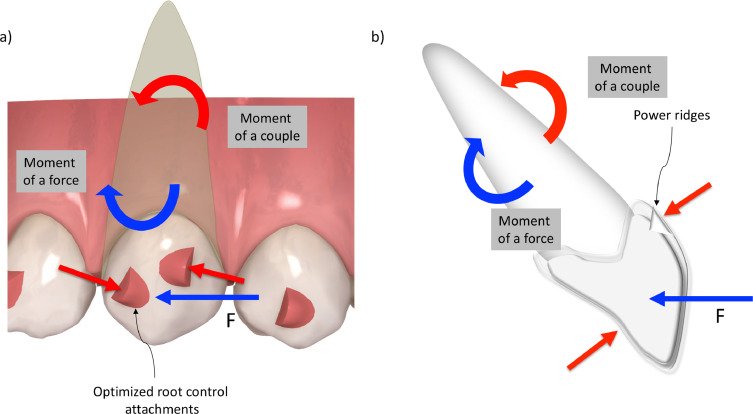
Attachments—custom composite shapes bonded to teeth—enhance grip and direct pressure precisely where needed.
2. Tipping vs. Translation
Aligners naturally favor tipping (crown-first movement). For full-body translation, we use optimized attachments and multi-step staging.
3. Vertical Movements
Intrusion and extrusion require advanced mechanics. We incorporate precision cuts, elastics, and vertical force zones to manage these movements safely.
4. Rotational Control
Rotating cylindrical teeth like canines or premolars demands specialized force vectors. Our aligner designs include torque-enhancing attachments and pressure points.
5. Root Torque & Anchorage
Root control is critical for long-term stability. We achieve torque through tray geometry and anchorage strategies—such as elastics or passive teeth—to prevent unwanted shifts.
Factors That Influence Aligner Efficiency
Several variables affect how well aligners perform:
- Material Composition: We use multilayer thermoplastics that balance flexibility with force retention.
- Patient Compliance: Wearing aligners 20–22 hours daily ensures consistent force application.
- Tray Fit & Staging: Accurate scans and strategic sequencing improve force transmission.
- Biological Variability: Bone density, periodontal health, and individual response rates impact movement speed and predictability.
Clinical Insight: Precision Is the New Standard
At OrthoAlign Solution, we don’t just move teeth—we engineer movement. Our aligner systems are built on biomechanical intelligence, digital planning, and patient-specific customization. Whether it’s torque control, vertical staging, or rotational refinement, every force is intentional.
Conclusion: Biomechanics Meets Digital Innovation
Clear aligners have revolutionized orthodontics—but their success depends on understanding the forces behind the movement. At OrthoAlign Solution, we integrate biomechanical principles with cutting-edge digital workflows to deliver results that are esthetic, efficient, and biologically sound.
The future of orthodontics lies in precision—and we’re building it, one aligner at a time.