
Diagnosing Limits for Safe Intrusion & Extrusion
By OrthoAlign Solution | Digital Orthodontic Workflow Experts
Vertical tooth movements—specifically intrusion and extrusion—are among the most nuanced challenges in clear aligner therapy. While aligners excel in esthetic and functional correction for mild to moderate malocclusions, vertical control demands a deeper understanding of anatomical boundaries and biomechanical strategy. At OrthoAlign Solution, we specialize in diagnosing and planning vertical movements with precision—ensuring safe, predictable outcomes through advanced imaging and aligner-based biomechanics.
Why Vertical Movements Require Specialized Planning
Unlike traditional braces, clear aligners rely on programmed force systems and surface attachments. Their flexible material and lack of fixed anchorage make vertical movements—especially extrusion—less predictable. That’s why our aligner protocols begin with a comprehensive diagnostic review using CBCT scans and digital modeling.
Core Diagnostic Factors for Intrusion & Extrusion
Before initiating any vertical movement, our team evaluates key anatomical and biomechanical parameters:
1. Root Length & Shape
Short or tapered roots increase the risk of resorption during vertical movement. CBCT imaging helps us assess root morphology and identify anatomical challenges like dilacerations that may resist force application.
2. Alveolar Bone Volume
Healthy bone height and density are essential for vertical stability. In cases with periodontal compromise, aggressive intrusion or extrusion may lead to mobility or attachment loss. Bone mapping ensures we respect biological limits.
3. Crown-to-Root Ratio
A long crown with a short root reduces anchorage and stability. Our digital setups factor in this ratio to avoid compromising long-term support—especially in extrusion cases.
4. Occlusal Load & Functional Habits
Teeth under heavy occlusal forces or parafunctional habits like bruxism may not respond predictably to vertical movement. We analyze bite dynamics to determine feasibility and adjust force vectors accordingly.
Case Examples: Intrusion vs. Extrusion
Case A: Intruding Overerupted Incisors
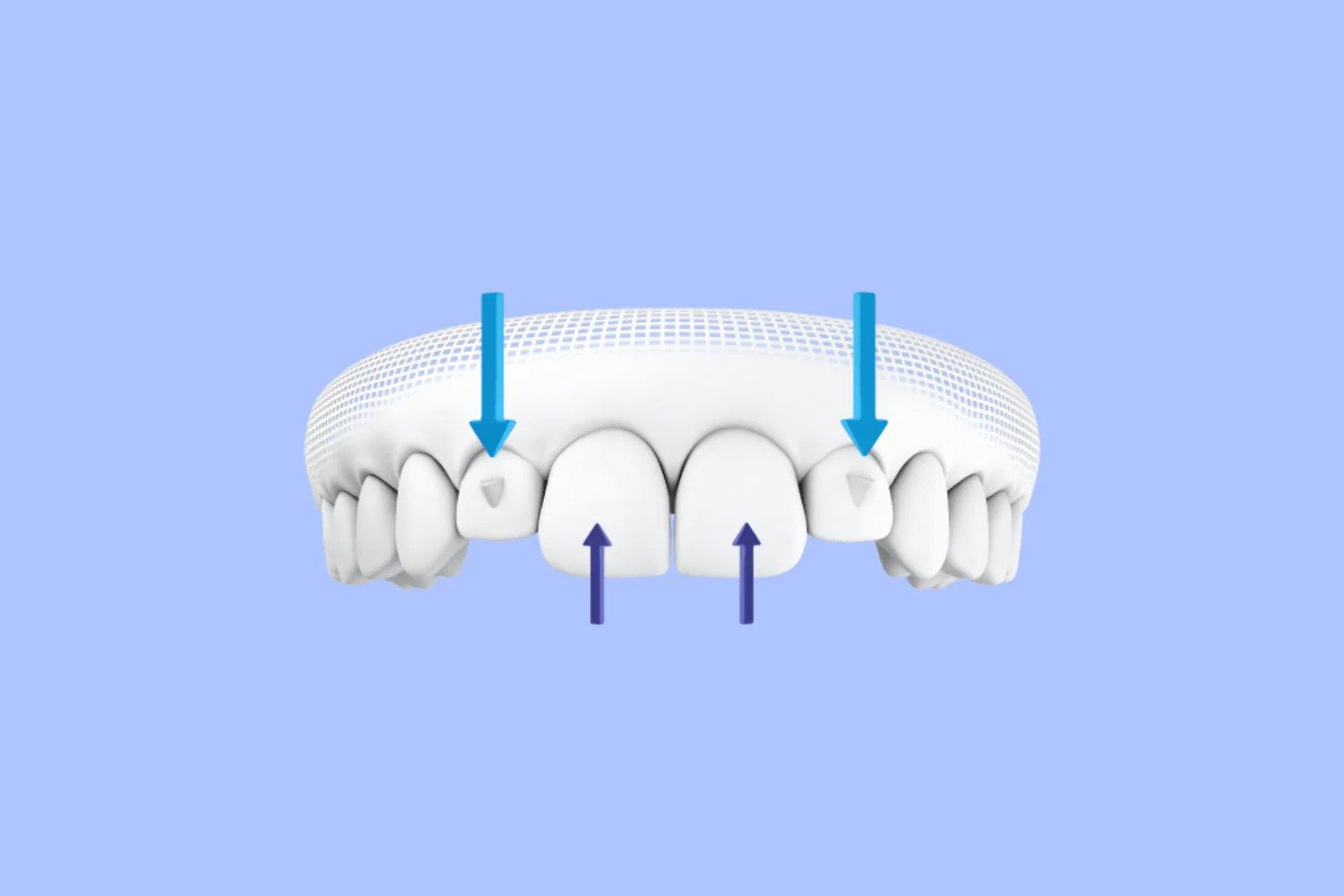
A patient with deep bite and flared upper front teeth undergoes staged intrusion using optimized attachments and sequential force programming. CBCT confirms favorable root length and bone support. Intrusion is limited to 1.5 mm per tooth, with optional interarch elastics for anchorage.
Case B: Extruding a Peg Lateral
For esthetic enhancement, a peg lateral is extruded to prepare for prosthetic build-up. Due to the short root and limited extrusion (<1 mm), composite attachments and aligner hooks with elastics are used. Bone support is adequate, and relapse risk is managed through overcorrection planning.
Tools to Enhance Vertical Control
At OrthoAlign, we integrate multiple biomechanical aids to improve vertical movement predictability:
- Optimized Attachments: Engineered for vertical force application on targeted surfaces.
- Auxiliaries: Elastics, bite ramps, and TADs provide supplemental anchorage when needed.
- Force Staging: Smaller, incremental movements across more aligner steps reduce biological stress.
- Overcorrection Protocols: Especially useful in extrusion cases prone to relapse.
Clinical Insight: Predictability vs. Possibility
Not all vertical movements behave the same. Intrusion tends to be more reliable with aligners—especially when posterior anchorage is strong. Extrusion, however, often requires external biomechanics and careful force calibration. Our planning philosophy balances ambition with anatomical reality.
Conclusion: Smart Diagnosis Drives Safe Vertical Movement
At OrthoAlign Solution, vertical tooth movement isn’t just a mechanical challenge—it’s a diagnostic art. By evaluating root integrity, bone support, and occlusal dynamics, we craft aligner protocols that respect biological limits while achieving esthetic and functional goals. Whether planning intrusion for deep bite correction or extrusion for restorative alignment, our digital-first approach ensures precision, safety, and scalability.