
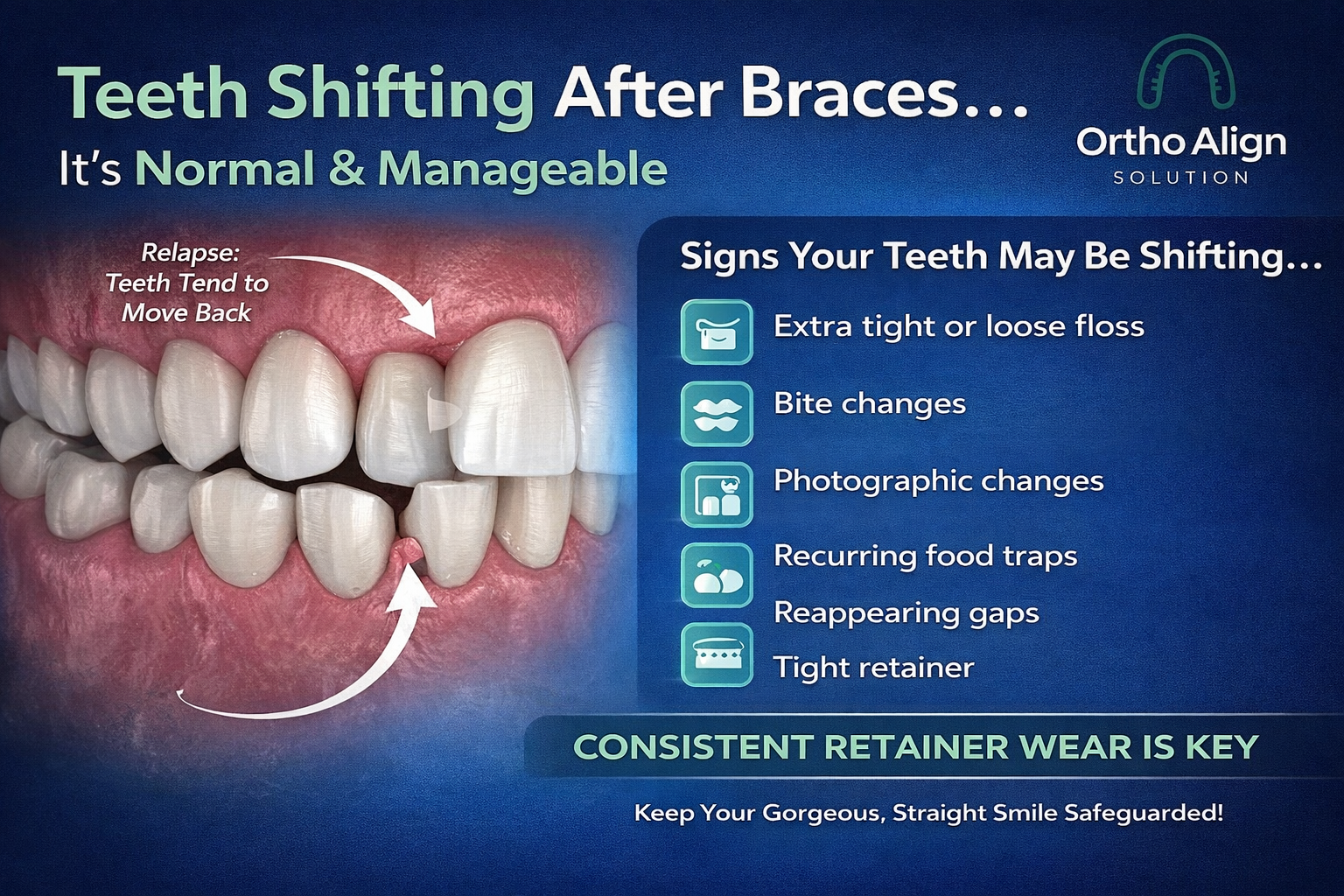
Why Do Teeth Sometimes Shift After Orthodontic Treatment?
Many of us undergo orthodontic treatment to improve our smiles—whether it’s closing gaps, straightening teeth, or achieving better alignment. The journey often takes months or even years of dedication, patience, and care.
However, after treatment is completed, you might begin to notice subtle changes: a tooth shifting slightly, a small gap reappearing, or minor overlapping. Naturally, this can lead to concern;
Has something gone wrong?
Has the treatment failed?
The reality is reassuring. What you’re experiencing is completely normal. Teeth have a natural tendency to move back toward their original positions, much like “memory foam.” This phenomenon is known as relapse, and studies show that 67% to 89% of patients experience some degree of post-treatment movement over time.
The good news? Relapse is manageable; especially when detected early.
How Do Teeth Actually Move?
To understand why teeth shift, it’s important to rethink how they are positioned in the mouth. Teeth are not fixed like nails in wood. Instead, they are suspended in a flexible, supportive structure within the jawbone. This structure allows for slight, natural movement to maintain balance and function. Orthodontic treatment works by applying controlled forces that guide teeth into ideal positions.
However, after treatment, the elastic fibers surrounding the teeth tend to pull them back toward their original alignment. This is a natural biological response—not a sign of failure. In simple terms, teeth are always in a state of subtle movement. Relapse simply reflects this natural tendency.
How Can You Tell If Your Teeth Are Shifting?
Early detection is key. Here are some common signs of relapse:
- The Floss Test
Floss suddenly feels tighter or looser between certain teeth. - Bite Changes
You notice one tooth hitting before the others when you close your mouth. - Photo Comparisons
Looking at older photos may reveal slight narrowing or changes in your smile. - Food Traps
Food consistently gets stuck in a new or unusual spot. - Reappearing Gaps
Spaces that were previously closed begin to return. - Tight Retainer
Your retainer feels tight or uncomfortable after skipping use—this is a major early warning sign. - Lower Front Crowding
The lower front teeth begin overlapping—this is the most common relapse area.
If you notice any of these signs, it’s important to contact your orthodontist early. Early intervention is typically faster, easier, and more cost-effective.
What Are Retainers?
After completing orthodontic treatment, many patients assume the process is over. In reality, this is where the maintenance phase begins.
A retainer is a custom-made device designed to hold your teeth in their new positions and prevent them from shifting back.
Types of Retainers
- Fixed Retainers
A thin wire bonded behind the teeth. It stays in place permanently and does not rely on patient compliance. - Removable Retainers
These can be taken out and are easier to clean, but their effectiveness depends on consistent use.
Clear plastic retainers (similar to aligners) are commonly used and are custom-fitted after a final scan of your teeth.
Research suggests that fixed retainers may be more effective for long-term stability, particularly for lower front teeth, though both types require proper care and hygiene.
How Long Should You Wear Retainers?
In the past, retainers were prescribed for a limited time (6 months to 2 years).
Modern orthodontics now recommends a different approach:
👉 Wear your retainer for as long as you want your teeth to stay straight.
For most patients, this means every night—indefinitely.
How Can You Prevent Teeth from Moving?
Preventing relapse requires consistency and commitment:
1. Initial Full-Time Wear
After treatment, retainers are typically worn 20–22 hours per day. This allows the bone and surrounding tissues to stabilize.
2. Transition to Nighttime Wear
After a few months, wear is reduced to nighttime only. This step is crucial for maintaining alignment.
3. Lifelong Maintenance
Teeth remain dynamic throughout life. Even skipping a few nights can lead to noticeable movement.
A tight retainer is often the first sign that relapse has begun.
Conclusion
Relapse is a natural and common part of the orthodontic journey—not a failure of treatment.
The key to maintaining your results lies in:
- Understanding why teeth shift
- Practicing good oral hygiene
- Attending regular dental check-ups
- Consistently wearing your retainers
Think of your retainer as an insurance policy for your smile.
Orthodontic treatment doesn’t truly end when braces or aligners come off—it transitions into a lifelong maintenance phase. With proper care and consistency, the smile you worked so hard to achieve can last a lifetime.
At OrthoAlign Solution, we are committed to supporting clinicians and patients with precise, high-quality digital treatment planning that helps achieve stable, long-lasting orthodontic results. Because a great smile isn’t just about alignment—it’s about maintaining it for life.
Remember: Wear your retainers every day… and keep your smile exactly where it belongs.